
1. Introduction: The Foundation of Modern Engineering
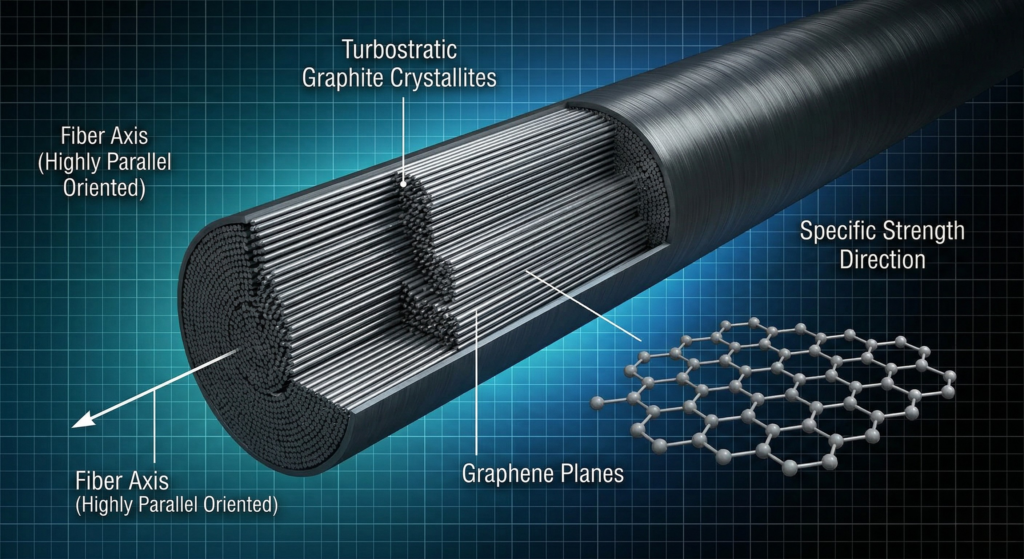
Carbon fiber is an advanced material with a carbon content exceeding 90%, renowned globally for its high strength, high modulus, low density, and excellent corrosion resistance. Produced by subjecting organic precursor fibers—such as polyacrylonitrile (PAN)—to extreme thermal treatments, its microstructure primarily consists of highly oriented graphite microcrystals.
Carbon fiber is rarely used alone. Instead, it is embedded in a matrix (like resin) to form Carbon Fiber Reinforced Polymer (CFRP) composites. Today, these composites are the driving force behind modern aerospace, defense, and most notably, the automotive industry. At Vurocabon, we leverage the incredible science behind CFRP to engineer premium carbon fiber car parts that deliver uncompromising performance and aesthetic appeal. This article explores the manufacturing processes, core properties, and why this material is revolutionizing the automotive world.
2. The Manufacturing Process Behind Premium Carbon Fiber
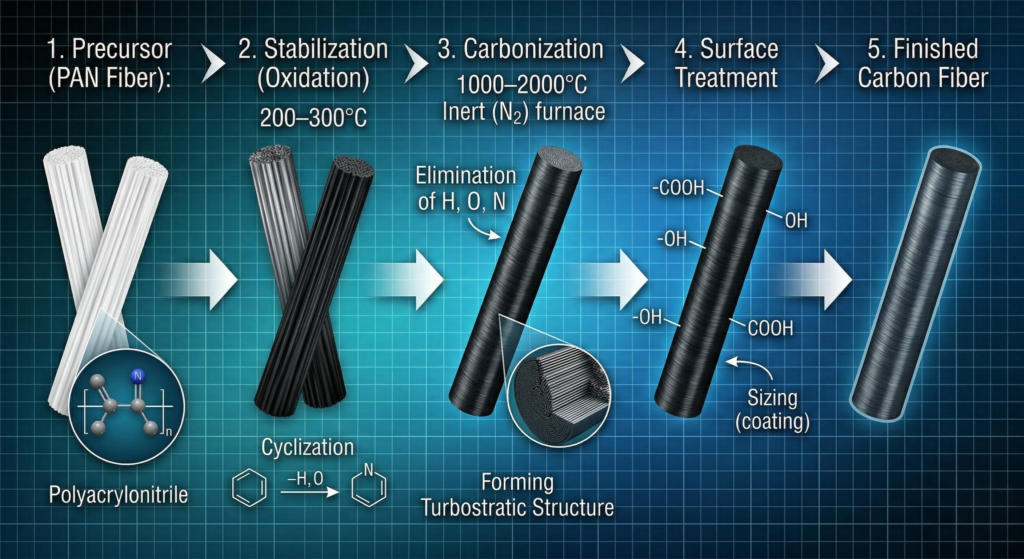
Creating the raw material for a high-quality carbon fiber car part is a rigorous process that requires absolute precision. The production involves four key stages:
- Precursor Selection: Approximately 90% of commercial carbon fibers use PAN as the precursor due to its high carbon yield and suitability for high-performance applications.
- Stabilization (Oxidation): In air at 200–300°C, PAN fibers undergo chemical reactions to form a thermally stable ladder structure, preventing melting during subsequent high-temperature treatments.
- Carbonization: In an oxygen-free, inert atmosphere at 1000–2000°C, non-carbon elements are driven off. This increases the carbon content to over 90%, forming a turbostratic graphite structure that gives the fiber its immense strength.
- Surface Treatment: The fibers undergo electrochemical oxidation or coating to introduce active functional groups. This ensures a flawless bond between the carbon fiber and the resin matrix—a critical step that Vurocabon prioritizes to ensure the durability of our carbon fiber auto parts.
3. Core Properties: Why Carbon Fiber is Ideal for Car Parts
The performance advantages of carbon fiber stem from its unique microstructure, making it the ultimate material for automotive upgrades:
| Property | Automotive Benefit (Why it matters for Car Parts) |
| Exceptional Specific Strength | Tensile strength can exceed 7000 MPa. It is roughly 10 times stronger than steel, drastically improving vehicle safety and structural rigidity. |
| Ultra-Low Density | Weighing less than a quarter of steel (1.7–2.2 g/cm³), carbon fiber car parts significantly reduce overall vehicle weight, directly improving acceleration, handling, and fuel/battery efficiency. |
| Fatigue & Corrosion Resistance | Unlike metal, carbon fiber does not rust. It is highly resistant to road salts, acids, and environmental wear, ensuring exterior auto parts last longer. |
| Thermal Stability | With a near-zero coefficient of thermal expansion, engine bay components and exterior aero parts maintain their exact shape even under extreme heat. |
4. Understanding Carbon Fiber Specifications
When shopping for a carbon fiber car part, you will often see specifications regarding filament count (tow size). Here is what they mean:
- Small Tow (1K, 3K, 12K): The “K” stands for 1,000 filaments. A 3K weave (3,000 filaments per tow) is the industry standard for high-end automotive applications. It provides the iconic, highly sought-after woven carbon fiber aesthetic while maintaining superior structural integrity. Vurocabon frequently utilizes premium 3K weaves for visible exterior and interior upgrades.
- Large Tow (48K and above): More cost-effective and typically used for hidden, heavy-industrial applications like wind turbine blades or structural chassis components.
5. Primary Application Fields
While carbon fiber serves multiple industries, its impact on the automotive sector has been the most transformative.
5.1 Automotive Industry: The Era of Lightweighting
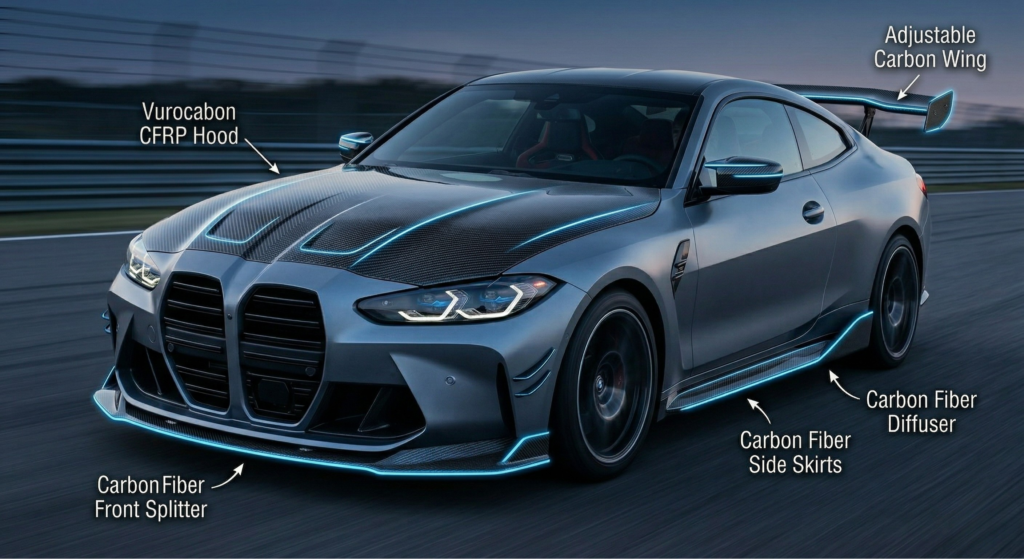
The demand for high-performance carbon fiber car parts is at an all-time high. Previously reserved for Formula 1 and hypercars, CFRP is now widely used for:
- Exterior Aerodynamics: Spoilers, front splitters, rear diffusers, and hoods. These parts reduce drag, increase downforce, and shed significant weight.
- Interior Trims: Steering wheels, center consoles, and dashboard replacements that offer a modern, race-inspired aesthetic.
- Chassis & Structural Components: Used in modern EVs and performance cars to offset battery weight and improve driving range.Brands like Vurocabon are at the forefront of this shift, providing enthusiasts and manufacturers with precision-engineered automotive components.
5.2 Aerospace and Defense
CFRP is a primary load-bearing structural material in large commercial aircraft (e.g., Boeing 787, Airbus A350), comprising over 50% of the structure by weight and reducing overall mass by 20–30%.
5.3 Wind Power and Sports Equipment
Large-tow carbon fiber enables massive wind turbine blades exceeding 100 meters, improving power generation. Additionally, its high stiffness-to-weight ratio makes it the standard for high-end golf clubs, bicycle frames, and fishing rods.
6. Future Development Trends
The carbon fiber industry is rapidly evolving. Future research is heavily focused on sustainability and accessibility:
- Eco-Friendly Precursors: Developing novel precursors (like lignin) to reduce raw material costs.
- Advanced Recycling: Perfecting pyrolysis and fluidized bed processes to recycle end-of-life carbon fiber car parts back into the manufacturing loop.
- Mass Production Efficiency: Lowering energy consumption during the carbonization phase to make carbon fiber upgrades more affordable for the everyday driver.
7. Conclusion
Dubbed the “king of new materials,” carbon fiber’s exceptional specific strength and design versatility have made it a cornerstone of modern engineering. As manufacturing technologies advance, carbon fiber is rapidly transitioning from a highly exclusive aerospace material to an accessible upgrade for automotive enthusiasts.
Whether you are looking to shave seconds off your track time or elevate the aesthetic of your vehicle, upgrading to premium composites is the ultimate solution. Explore Vurocabon’s extensive catalog of high-quality carbon fiber car parts today, and experience the future of automotive performance.