
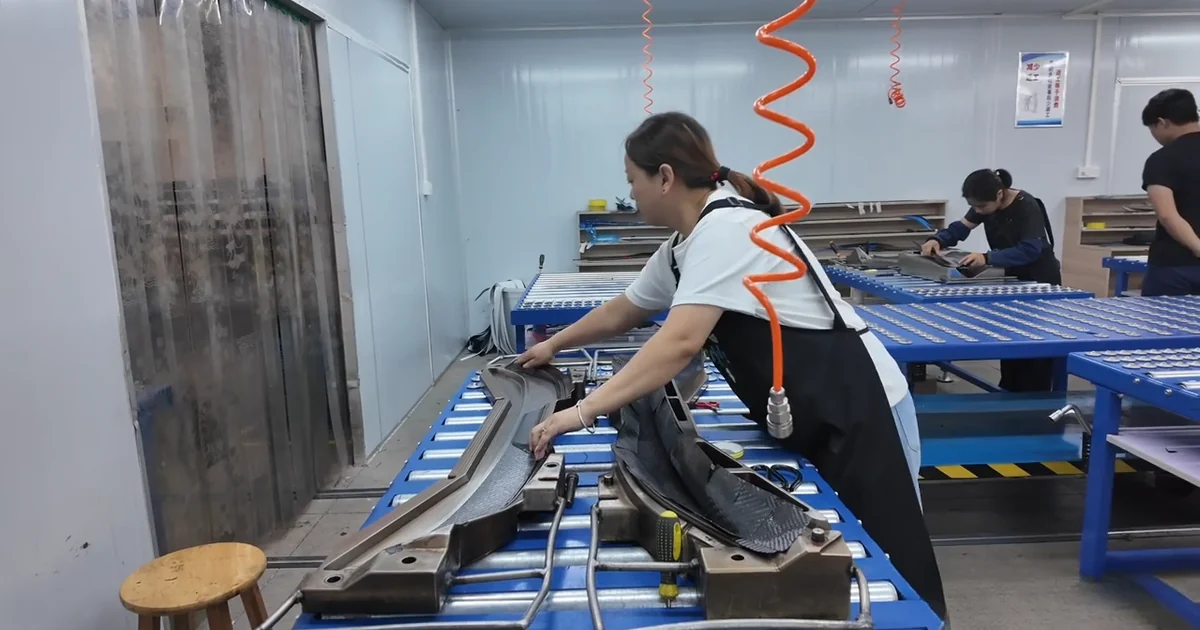
Diffuser Carbon Fiber: Technical Performance, Material Science, and Verified Fitment
A diffuser carbon fiber assembly is a rear underbody aerodynamic device that accelerates and expands airflow leaving the vehicle floor. Correct geometry can improve rear stability, reduce wake turbulence, and cut mass versus many OEM plastic units.

Aerodynamic Function: Why Diffuser Geometry Matters

Rear diffusers work by controlling pressure recovery as air exits the underbody. Effective designs balance ramp angle, throat area, and strake placement to limit flow separation. For many street/track dual-use platforms, an effective ramp range near 7–12° is commonly more stable than visually aggressive shapes with poor floor sealing.
- Primary objective: improve rear axle aero consistency at speed.
- Secondary objective: reduce underbody turbulence and wake drag.
- System requirement: diffuser performance depends on undertray continuity, ride height, and exhaust thermal management.
Material Engineering: 3K Twill, Forged Carbon, and Hybrid FRP
Carbon Type Selection
3K twill: predictable weave alignment, strong cosmetic consistency, balanced cost/performance.
Forged carbon: random-chip aesthetic, premium positioning, often higher unit cost.
Hybrid FRP + carbon skin: lower price, acceptable daily durability, typically lower stiffness than full-carbon layups.
Construction Quality Indicators
- Uniform resin distribution with no pinholes or dry spots.
- Reinforced mounting bosses at high-load fastener zones.
- UV-resistant clear coat with consistent thickness and edge coverage.
- Controlled post-cure process to reduce warping and long-term print-through.
Fitment Protocol: Eliminate Compatibility Errors
Use strict identification before checkout: Make → Model → Year → Chassis code → Trim → Bumper variant → Exhaust layout.
| Validation Point | Target | Tolerance / Note |
|---|---|---|
| Rear bumper type | OEM / M Sport / S-Line / Performance | Mismatch commonly causes tab stress and gap issues |
| Mounting point alignment | Factory hole map match | 5–15 mm offset may require adapters or rework |
| Exhaust outlet geometry | Single / Dual / Quad / Center | Maintain thermal clearance and avoid tip contact |
| Ride height + rear lip | No interference through suspension travel | Check compression/curb approach scenarios |
Installation Standard (Condensed)
- Dry-fit diffuser and center to bumper datum points.
- Mark all mounting locations with tape + transfer points.
- Pre-drill only where required; deburr edges.
- Install hardware from center outward to control stress.
- Apply final torque sequence; recheck after 80–160 km.
Critical checks: panel symmetry, fastener preload consistency, and ≥10 mm heat clearance near exhaust.
Comparison Matrix: Quick Selection by Use Case
| Use Case | Recommended Construction | Aero Priority | Typical Budget |
|---|---|---|---|
| Daily OEM+ | 3K twill or hybrid FRP + carbon | Moderate fin depth, high fit accuracy | $400–$700 |
| Street/Track | Full carbon with reinforced mounts | Balanced strake geometry + underbody sealing | $700–$1,000 |
| Premium Build | Forged or advanced full-carbon layup | Platform-specific aggressive aero package | $1,000+ |
EEAT: Engineering Authorship and Quality Assurance
Technical reviewer: Marcus Chen, Lead Product Engineer (aero fitment and composite component validation).
Evaluation basis: platform test-fits, thermal clearance checks, mounting load-path inspection, and finish QC under directional lighting.
Proper flange flatness, controlled torque sequence, and minimized centerline gap are higher-impact to real-world stability than oversized cosmetic fins.